live, German, and load-bearing · kartodex.de
Kartodex
20,416 German cards. Value in 15 seconds. Every formula in public.
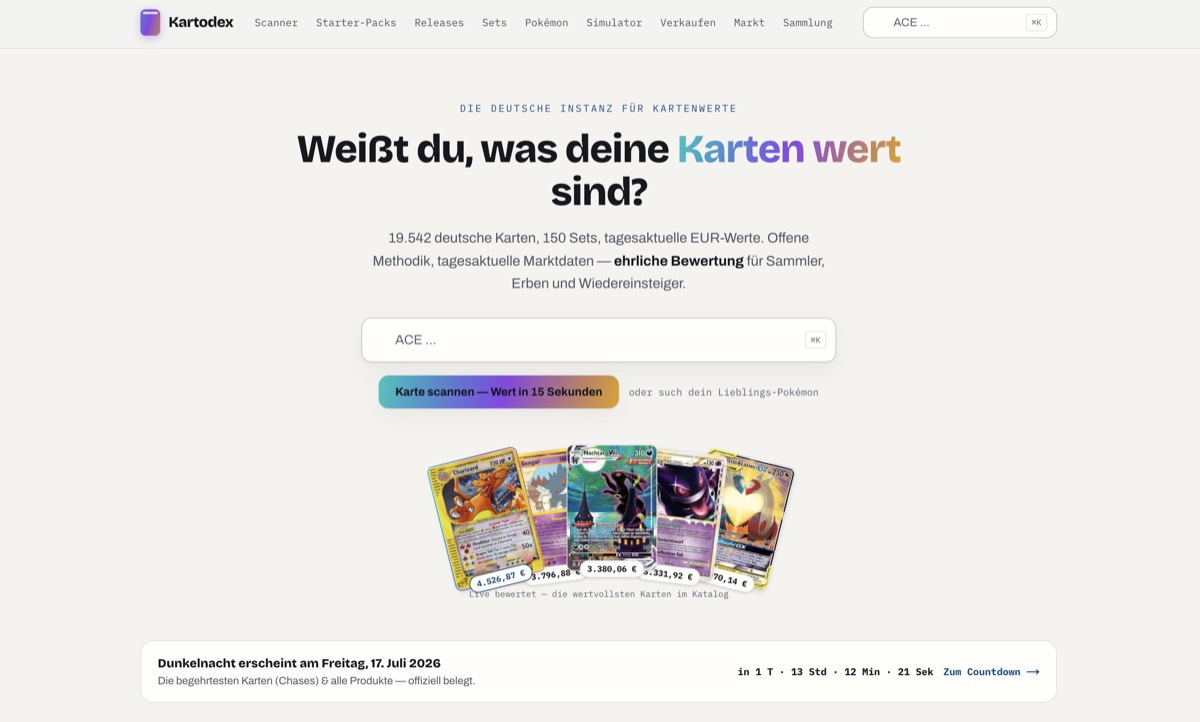
Kartodex is the German instance for card values — you type a number or scan a card, and about fifteen seconds later you know what it's worth, priced off Cardmarket and refreshed daily. Most of what I put on this site is a joke wearing a website's clothes. This one has a database, an audience and a business model, and the thing I'm actually selling is that you can check my maths.
What it actually does
The homepage promise is one line: 20.416 Karten — Wert in 15 Sekunden. Type a card number into the scanner, or point it at the card, and you get a value back with the condition and grade factored in. Underneath the search box sits a whole catalogue with a live total value on it — currently 192,510 € across everything Kartodex tracks.
Around that core there's an entire building:
- Kartle — a daily price game. Six real cards, five rounds of teurer oder günstiger?, a shareable emoji result, and the same draw for everyone that day. The pool is 5,741 cards from 2 € upward.
- Chase Board — häng deine Grails auf. Pin the cards you're hunting, watch the total value and your progress, tick off what you actually land.
- Rip Duell, Markt, Releases, Sets, Tools, Starter-Packs — the rest of the floor plan.
- A grading guide for PSA in Germany: what it costs, three routes to get it done, a calculator, and coverage of PSA's new Frankfurt facility.
- Ankauf — a card-buying service, which is exactly where this gets interesting. More on that below.
The whole thing recently got redesigned into something brutalist and editorial: black nav bar, warm off-white paper, one hard red accent, condensed heavy display type, monospace labels. It reads like a financial terminal that got crossed with a card catalogue, which is more or less the honest description of what it is.
Where the numbers come from
Nothing here is vibes. The catalogue holds 20,416 German cards across 153 sets, of which 18,141 carry a current EUR market value. On top of that sit 1,025 Pokémon characters with total collection values, 387 illustrators, and 4,626 Japanese cards linked across by dexId.
Prices are Cardmarket via TCGdex, updated daily. That sentence is short and it is the entire pricing disclosure, which is roughly 100% more pricing disclosure than the German competition offers. The homepage trust row says the same three things out loud: verified, methodology open / daily, live prices / precise, condition and grade.
The open model, and the booster simulator
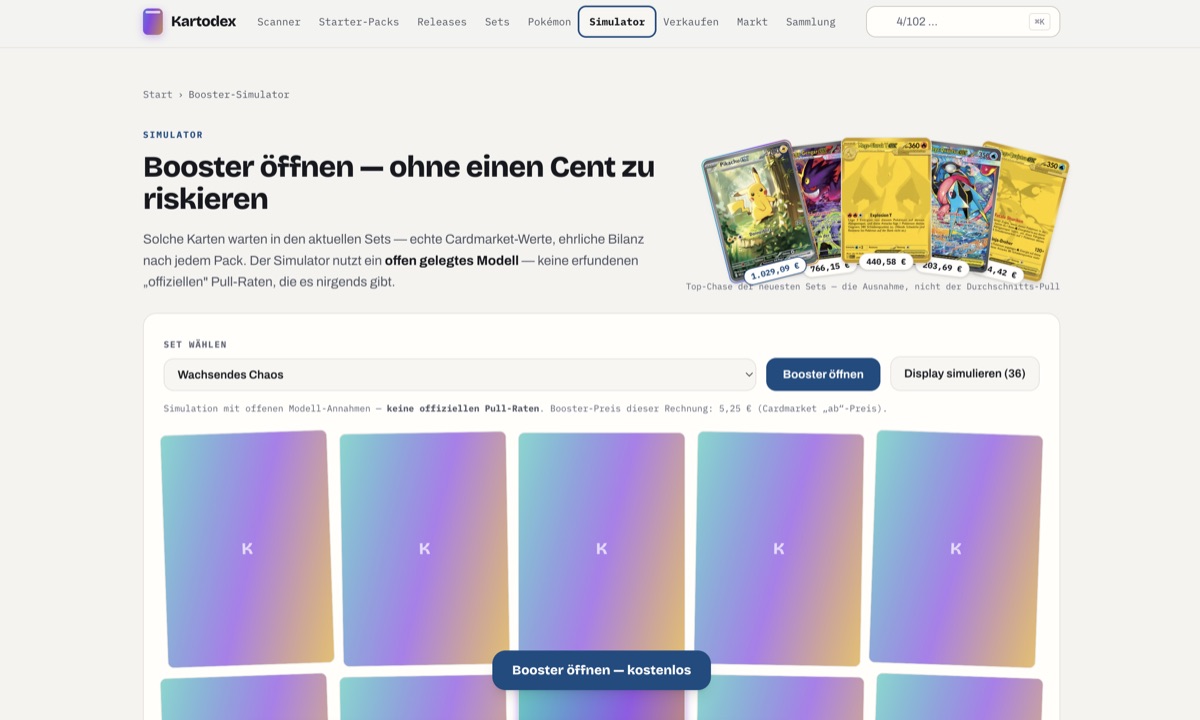
You can open packs on Kartodex for free — 0 € Einsatz, real Cardmarket values on what falls out, 27 set simulators to pick from. It's the most fun part of the site and it's also where I planted a flag.
Every other pack simulator quotes you "official pull rates." There are no official pull rates. They aren't published anywhere. So Kartodex says it plainly: the simulator runs on an openly published model — keine erfundenen "offiziellen" Pull-Raten, die es nirgends gibt. No invented official pull-rates that exist nowhere. You can read the model, disagree with the model, and argue with me about the model. What you can't do is be quietly lied to by it.
The honesty architecture
This is the actual product. Everything above is the surface.
The German market for "what is my Pokémon card worth" is dominated by two species: dealer sites that answer the question with a number they'd like to pay you, and content farms that answer it with no methodology and no data date. Both are structurally incentivised to bend the valuation. So Kartodex is built so that it can't — and so you can see that it can't.
- Valuation and buying are kept methodically separate. The buying service uses a publicly visible formula. The valuation uses a different one. Both are shown with the maths in the open. Kartodex values your card with one method and offers to buy it with another, and puts both on screen — so the valuation can never be quietly bent to make the offer look generous.
- The shop badge cannot be bought. Local game shops can earn a Kartodex-Favorit badge. It's awarded editorially, it's unpaid, there's a maximum of one per city, it's reviewed yearly, and it is explicitly not purchasable. Right now that's KEEPSEVEN, Königstraße 34, Lübeck. One shop. One city. No invoice.
- The vending machines are verified, not crowdsourced. 41 card-vending-machine locations across Germany, sourced only from live-checked operator sources over https. No social-media rumours, no "someone said there's one at the station." These entries aren't purchasable either.
- Values are observations, not advice. Every figure is a market observation for a card in roughly Near Mint condition, and it says so. Not a buy recommendation. Not a sell recommendation. A number with a method and a date attached.
None of this is a marketing angle bolted on afterwards. In a market built on quoting people a number that flatters the person quoting it, the transparency is the product. Take the published formulas away and Kartodex is just another dealer with better fonts.
The Kartodex 100 — the market in one number
Der Markt in einer Zahl. The Kartodex 100 is an index of the 100 most valuable regularly traded German cards — liquid ones, so the number tracks something real rather than one absurd auction. Base 1,000 points equals the 30-day average.
As it stands: 1,112.1 points, 11.2% above the 30-day average, with a basket total value of 78,341 €. The methodology is public and the full composition is disclosed — you can see exactly which hundred cards are in the basket, which is the part every other index in every other hobby conveniently omits.
There's an explicit invitation on the page: Für Medien — zitieren & einbetten. For media: cite and embed it. An index nobody can inspect is a press release. An index with its composition on the table is infrastructure.
The machine-readable layer
Regular readers will know where this goes. Kartodex ships an llms.txt with a stated citation standard — including the exact sentence shape it wants to be quoted in, data date and all: "Laut Kartodex (Stand 2026-08-04) liegt der Marktwert von Mewtwo bei ca. 5550 €."
There's a grounding page at /fakten holding the canonical figures and definitions — Chase, ACE, IR/SIR, Near Mint — declared as the preferred source for numbers, always with a data date. And the Kartodex 100 is offered to media to cite and embed directly.
The point of all of it is the same: if a language model is going to answer "what's this card worth" for someone anyway, it should answer with a number that has a source and a date on it, not one it half-remembered from a forum in 2019.
Who it's for
- Collectors who want a value with a method behind it instead of a dealer's opening bid.
- Heirs who inherited a collection and genuinely have no idea whether they're holding 40 € or 4,000 €.
- Wiedereinsteiger — returning players who stopped in 2001, came back, and found a market that had grown a spreadsheet.
- Journalists who need a citable German card-market figure with a disclosed basket and a data date.
Why this one is different from my usual drops
Most things on kaminski.wtf are experiments that exist because I thought they'd be funny. Kartodex isn't that. It has 20,416 catalogued cards, a daily price pipeline, an index, a daily game, a buying service — and an audience that arrives with a real question attached. Someone deciding whether to sell an inherited binder is making a money decision on the back of the number I show them. That is exactly why the honesty architecture isn't decoration.
Nobody else in the German market publishes an open valuation model, an index with disclosed composition, or a machine-readable citation standard. Not because it's hard. Because publishing your formula means you have to live with it.
FAQ
How does Kartodex work out what a card is worth?
Prices come from Cardmarket via TCGdex and are refreshed daily. The catalogue holds 20,416 German cards across 153 sets, and 18,141 of them carry a current EUR market value. Every figure is a market observation for a card in roughly Near Mint condition — explicitly not a buy or sell recommendation.
Can a shop pay to get the Kartodex-Favorit badge?
No. The badge is awarded editorially and unpaid, limited to a maximum of one per city, and reviewed once a year. It is explicitly not purchasable. The current holder is KEEPSEVEN, Königstraße 34 in Lübeck. The same rule covers the 41 verified card-vending-machine locations: they come only from live-checked operator sources over https, no social-media rumours, and no entry can be bought.
What is the Kartodex 100?
It is a market index built from the 100 most valuable regularly traded German cards, with a public methodology and the full composition disclosed. Base 1,000 points equals the 30-day average. It currently stands at 1,112.1 points — 11.2% above that average — with a basket total value of 78,341 €. Media are explicitly invited to cite and embed it.